
Australia’s economic security in an imbalanced world
Thank you to the United States Studies Centre for bringing together this discussion of economic security and resilience.
This year has presented an unusually wide range of challenges. Conflict has disrupted the energy markets we depend on. AI development is accelerating, yet our access to the frontier has become less certain. Interest rates are rising globally due in part to more persistent inflation – as growing investment in data centres, defence and other sectors increases pressure on capital and resources. And all of this is amidst intensifying geopolitical competition and a more volatile and fragmented international environment.
These events bring a now familiar challenge into focus: how to preserve the benefits of an open economy while enhancing our resilience.
So before discussing economic security and Treasury’s perspectives, I’d like to begin today by examining an issue that sits behind some of the economic and geopolitical tension we face: global imbalances.
Global imbalances
As you all know, when people talk about global imbalances, it’s shorthand for a simple idea: that some countries run persistent surpluses with the rest of the world and others run persistent deficits.
Viewed through a capital flows lens, this is the gap between what a country saves and invests domestically. Through a trade lens, it’s the gap between a country’s exports and imports, adjusted for income flows like dividend streams.
The maths of macroeconomics tells us these are 2 sides of the same coin.
- A country that saves more than it invests – what we call a surplus economy – will export more than it imports. Prominent examples include China and Germany.
- By contrast, a country that invests more than it saves – a deficit economy – will import more than it exports. The largest deficit economy is the United States, alongside some large European economies such as the UK.
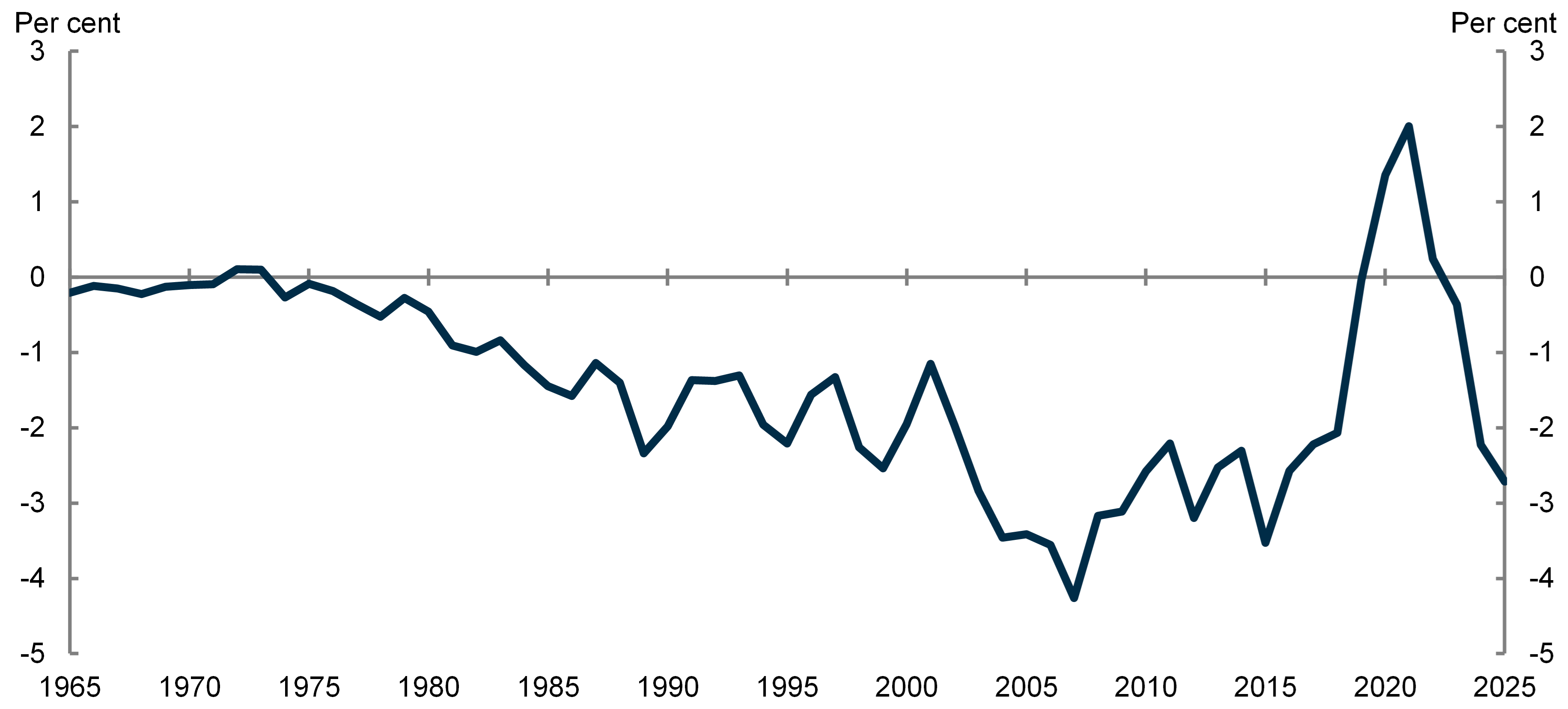
Australia’s experience shows there’s nothing inherently wrong with deficits or surpluses. We recorded deficits from the 1970s until 2019, in part because we needed foreign capital, alongside domestic savings, to develop our large resource and energy endowments. Exports from those projects, coupled with high commodity prices, helped push the balance into surplus in 2019. It has since returned to deficit, reflecting market developments as commodity prices eased and imports recovered post‑COVID. Australia can sustain a current account deficit because the investment it finances contributes to higher GDP.
Chart 1: Australia’s current account balance (% of GDP)
Source: ABS Balance of Payments and International Investment Position
It’s inevitable some countries will run surpluses while others run deficits – a difference that reflects factors such as each country’s level of development, demographic profile, and resource endowments.
But differences in current account balances become a concern when they’re larger than economic fundamentals would imply.
Why is this a problem?
Broadly, it’s because excessive imbalances can have damaging spillover effects. One risk is a sudden stop. That is a situation where a deficit economy can’t access enough capital to sustain that deficit, leading to a painful adjustment like a debt crisis or a rapid currency depreciation. This is what occurred in the late‑1990s Asian financial crisis.
But noting the current global environment, another risk is worth highlighting. History shows that when excessive imbalances persist, this often spurs geopolitical tensions, as deficit economies try to manage the domestic threat posed by exports from surplus economies.
Resolving global imbalances is difficult. It requires individual countries to make adjustments that demand political will – for example, deficit economies taking steps to increase savings and improve export competitiveness, and surplus economies boosting domestic consumption and investment.
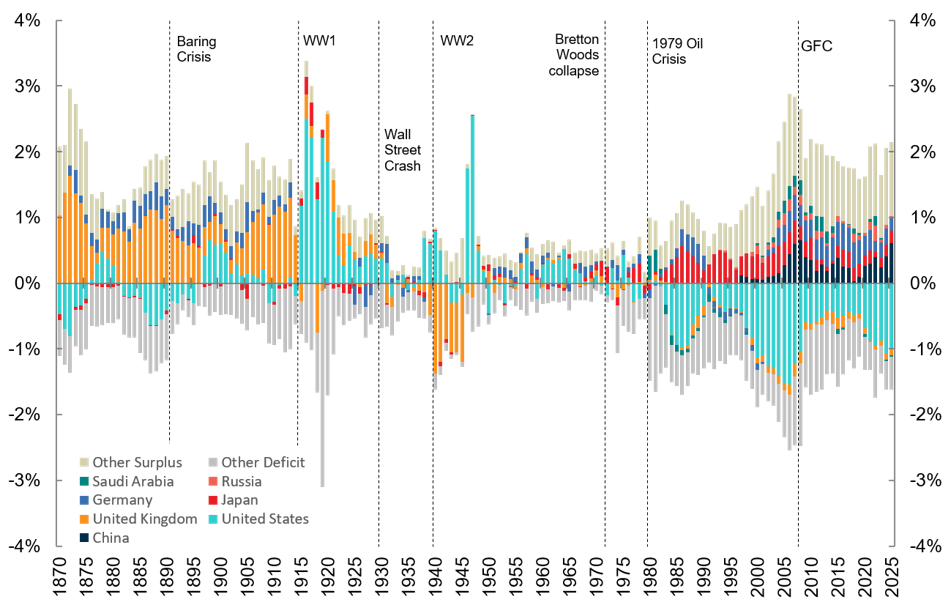
Many insights can be drawn from looking at a long history of imbalances (Chart 2). For instance, large imbalances have become more persistent since the 1970s, even though the opposite might have been expected following the post‑Bretton Woods shift towards floating exchange rates. There are likely many reasons for this, including the demand for US Treasuries driven by US dollar’s reserve currency status.
Another observation is that the structure of imbalances can be utterly transformed by major events – as when World War 1 suddenly turned the US into the world’s largest surplus economy.
But excessive imbalances can also spur tumultuous events. For instance, concerns about imbalances last peaked around the 2008 global financial crisis, which was attributed in part to the global savings glut, alongside factors like poor risk management in the financial sector. Those concerns waned as imbalances abated post‑crisis: current account surpluses as a share of global GDP fell from almost 3 per cent in 2006 and 2007 to just over 1.5 per cent by 20191.
Chart 2: Global current account imbalances as a share of world GDP
Source: Jorda‑Schularick‑Taylor (2017), IMF World Economic Outlook and Treasury calculations. Figures prior to 1980 are based on a sample of 18 advanced economies. 2025 includes some preliminary data.
Since the COVID‑19 pandemic, imbalances have begun widening again, with current account surpluses above 2 per cent of global GDP in 4 of the past 5 years. That has revived concerns about the issue and put it on the agendas of this year’s G7 and G20 meetings2.
And this time, the worry isn’t primarily about economic impacts. There are increasing concerns about the strategic and national security implications of some of these persistent imbalances.
The IMF’s latest annual survey of imbalances noted China’s current account surplus increased by about US$300 billion in 2025, or a quarter of a per cent of global GDP. According to the IMF, in absolute terms this was the largest widening of a current account surplus by an individual country over the past quarter century3.
China isn’t just exporting more – it’s moving up the value chain and securing a growing global share of high‑tech manufacturing.
Basic accounting tells us the expansion of China’s current account surplus must be mirrored by a commensurate increase in deficits elsewhere4– that is, countries saving less relative to what they’re investing, and importing more relative to what they’re exporting.
In many economies, this is reflected in the domestic industrial base shrinking in relative terms – reinforcing a long running trend – and even in absolute terms for some key strategic industries like steelmaking5 and shipbuilding6.
And more concentrated global production for certain inputs has raised awareness about vulnerabilities in a globally connected world to economic chokepoints. This year’s blockage of crude oil shipments through the Strait of Hormuz, last year’s curbs on exports of rare earth elements, and constraints on access to frontier AI models have brought these issues into sharp relief.
Economic security
So global imbalances, alongside significant increases in great power competition and technological change, have led to the increased focus on what’s now labelled ‘economic security’ – meaning a country’s ability to sustain its prosperity by strengthening its resilience to shocks.
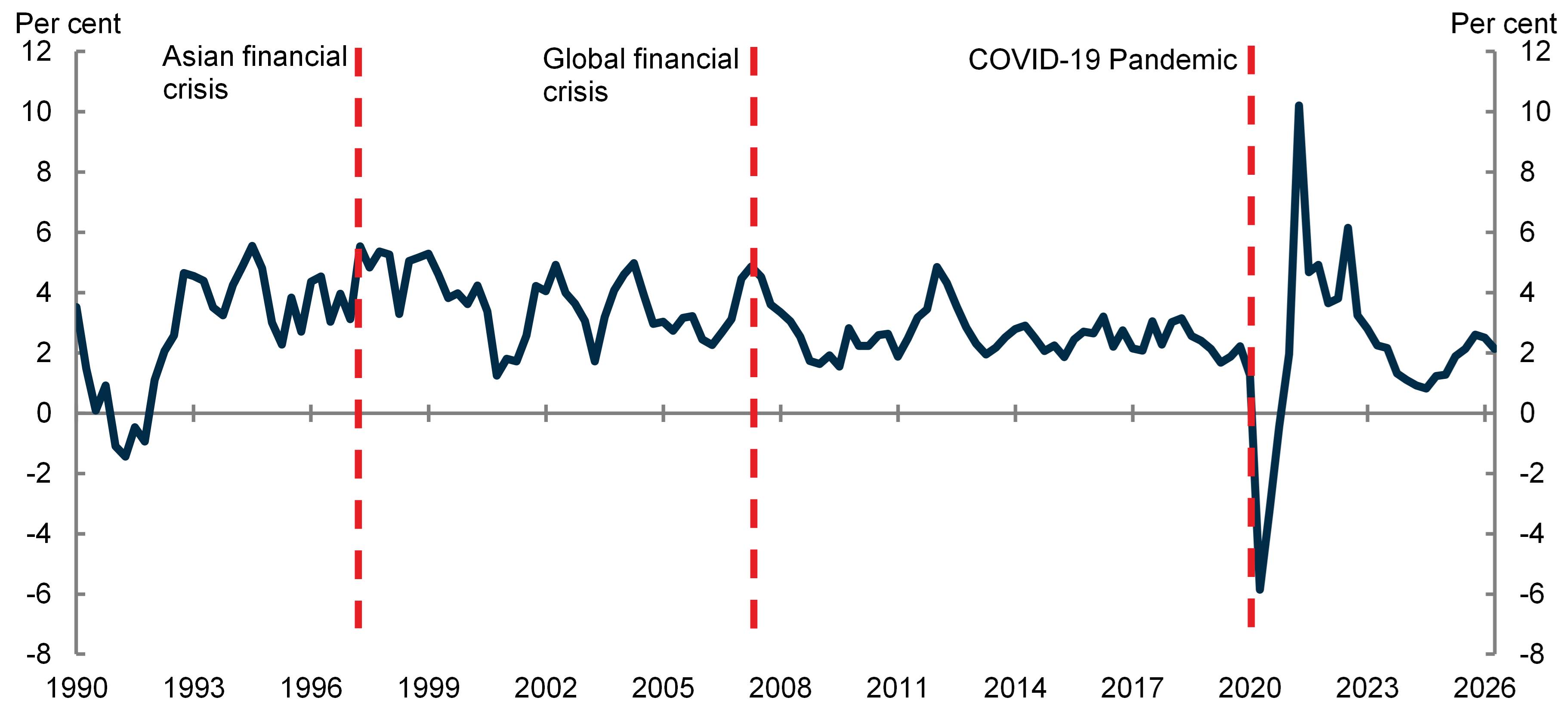
Economic shocks aren’t new. In recent decades, the global economy has endured events like the Asian financial crisis, the 2008 global financial crisis, the 2020 global pandemic, and the 2022 energy shock associated with the Russian invasion of Ukraine.
Chart 3: Australian annual GDP growth
Source: ABS National Income, Expenditure and Product
Australia’s economy showed remarkable resilience through these episodes – demonstrating that the best defence against shocks is a flexible economy and a government with the fiscal space to respond.
But these defences are no longer enough. Economic security risks are rising owing to escalating geostrategic competition, rapid technological change, and the growing weaponisation of economic dependencies for strategic ends.
Just reflect, once again, on the events of this decade. Both the COVID pandemic and the Strait of Hormuz closure demonstrated the destabilising impact of disrupted supply chains. We have experienced countries restricting their exports or imports in an attempt to shape the behaviour of others. And the tempo of cyberattacks disrupting critical services has increased, with concerns such incidents will become more common owing to advances in artificial intelligence.
In response, governments are giving more weight to resilience relative to economic efficiency, leading to interventions I barely could have imagined earlier in my career. In July, the UK government nationalised British Steel amid concerns its closure would threaten strategic supply chains. Last year, the US imposed tariffs of 10 per cent or more on almost all countries, citing a national emergency caused by foreign trade practices hollowing out US manufacturing. The US and China have exchanged export controls on an expanding range of items. And the IMF reports the number of industrial policies announced globally in 2025 was 2.5 times the annual average before COVID7.
Let’s be clear: these types of interventions can undercut economic efficiency, by which I mean using resources in a way that enables goods and services to be produced at the lowest possible cost. But prosperity – which is our ultimate goal – depends on more than efficiency. It also depends on our ability to withstand shocks. So, we must keep reassessing our policy mix to ensure it’s striking the right balance between efficiency and resilience.
Australia’s approach
What does this mean for Australia?
As I mentioned earlier, I strongly believe that the foundation of our resilience remains our flexible economy, commitment to a rules‑based international order, and fiscal health. The government’s pursuit of free trade arrangements and removal of tariffs is a demonstration of their ongoing commitment to these established policy approaches to reduce barriers to trade and boost economic performance.
But aware of the growing likelihood and scope of economic security risks, we’re developing a bigger toolbox.
For example, in the investment space, the foreign investment framework continues to be updated to achieve the right balance between mitigating national security risks and facilitating inwards investment.
On trade, the government has shown it can quickly deploy funding in response to supply chain shocks – as with the $7.5 billion Fuel and Fertiliser Security Facility introduced this year to support inflows of fuel and fertiliser following the disruption in the Strait of Hormuz8. And initiatives like the Critical Minerals Facility can support supply chain resilience, such as by strengthening our ability to produce key inputs at home or by expanding reserves and stockpiles.
In relation to cyber and other threats, the Security of Critical Infrastructure framework continues to be strengthened to ensure that the infrastructure that underpins our economy and provides essential services is more resilient.
And recognising there are many shocks we can’t manage alone, the government continues to work with international partners in areas like supply chain resilience and cyber threats.
Of course, Australia’s ability to harness such partnerships draws on what we offer – including our value as a trusted, reliable partner. We can make ourselves indispensable to our partners by investing in the parts of global supply chains where they’re most vulnerable to chokepoints and where we have comparative advantage – critical minerals being an example.
And whereas an economy the size of the US can pursue a level of self‑reliance, we have to recognise that we are too small to take that path. So, we need to work with partners and be judicious about investments to boost resilience – being alert to the risk that national security can be used as a crutch to justify industrial policies that undermine allocative efficiency.
These choices are akin to insurance – deciding what level of cover is appropriate to mitigate the impact of unpredictable events. Some shocks are large enough and likely enough that it’s worth paying a large premium today to reduce potential costs in the future – to ensure we retain access to the most essential goods and services. But for other potential shocks, we may judge the up‑front cost of insurance isn’t warranted – and that the smarter approach is to rely on the flexibility and responsiveness that’s got us through past crises.
Treasury’s role
These are difficult choices that have challenged Treasury’s traditional worldview. In the past, our advice to government attached relatively little weight to the role of resilience and sovereign capability. But we recognise the world has changed. We’re not abandoning economic thinking – we’re applying it in a different context.
In line with recommendations of the 2024 Independent Intelligence Review, we’ve established a distinct economic security function within Treasury. Working closely with the intelligence community, its role is to support government agencies to identify appropriate policies to mitigate economic security risks – by assessing the costs of a shock to the economy and society, considering policy options to mitigate those costs, and identifying response options that are proportionate to the risk.
This team is also responsible for the National Interest Framework under the Future Made In Australia Act which is a framework for assessing where government support to sectors critical to economic security and resilience may be needed to unlock sufficient private investment.
More broadly, many groups across my department are now engaged in economic security policy in ways we wouldn’t have imagined even 10 years ago.
This ranges from Macroeconomic Group investing in modelling capability to assess the economic implications of geopolitical developments, to Markets Group leading work with the Council of Financial Regulators on geopolitical risk.
It includes Fiscal Group supporting line agencies to progress proportionate investments to manage risks and Revenue Group work on strategic tax measures such as the Critical Minerals Production Tax Incentive.
And, in addition to the economic security functions mentioned, International Group is responsible for foreign investment policy and progressing more targeted risk‑based foreign investment reforms.
Conclusion
To conclude, the challenging geopolitical environment we face is structural. Great power competition isn’t going away. Technological change is continuing at pace. And current account imbalances are expanding again, posing risks to the global economy, and exacerbating national security tensions.
This changing landscape is creating difficult choices for government. As a nation, we’ve always sought to build resilience to shocks. But as the threats increase, so does the cost of insuring against them.
As Treasury supports the government to navigate these decisions, we’ll be guided by a few key principles. Open markets remain critical to Australia’s prosperity, including our ability to withstand severe shocks. But tightly targeted interventions are warranted to further strengthen our resilience. As is collaboration with other countries, drawing on our indispensability as a strategic partner.
The world has changed. And so have we. The Australian Government is building a bigger toolbox, with Treasury playing a central role.
1 IMF ESR Figure 1.1: 2026 External Sector Report: Chapter 1, the IMF calculates the headline global current account balance by the sum of the absolute values of all individual national current account surpluses and deficits.
2 In 2026, Treasury co‑chaired a G20 Study Group with the Republic of Korea on global imbalances.
3 2026 External Sector Report: Chapter 1, p1: ‘The widening of global balances in 2025 was predominantly driven by China and mirrored by narrowing surpluses or expanding deficits in a diverse group of countries (Figure 1.2). China’s current account surplus increased by about $300 billion (¼ per cent of world GDP) in 2025, marking the largest current account widening (in absolute terms) over the past 2 and half decades (Figure 1.3)’
4 Note that current account balances don’t necessarily add to zero at the global level owing to measurement issues.
5 See OECD Steel Outlook 2025 (EN). Figure 1,1 shows an absolute decline in OEC steel production since 2005.
6 Ships built by country of building. Data by Countries from 2014 to 2025
7 Industrial Policy Is Adapting to Crises, but Remains Hard to Implement Effectively
8 Explainer: Fuel and Fertiliser Security Facility – fertiliser price‑risk support – DAFF